[!NOTE]
What you are doing: Locating the Meibomian gland openings and establishing the strict boundary of safe eyeliner tattooing.
Why you are doing it: Tattooing into the waterline permanently destroys oil-producing glands and causes chronic dry eye disease.
How you know it is right: Your needle never crosses the lash line into the posterior mucosal margin.
Ocular permanent makeup demands absolute clinical precision. The eyelid contains the thinnest skin on the human body (approx 0.5mm) and directly protects the cornea:
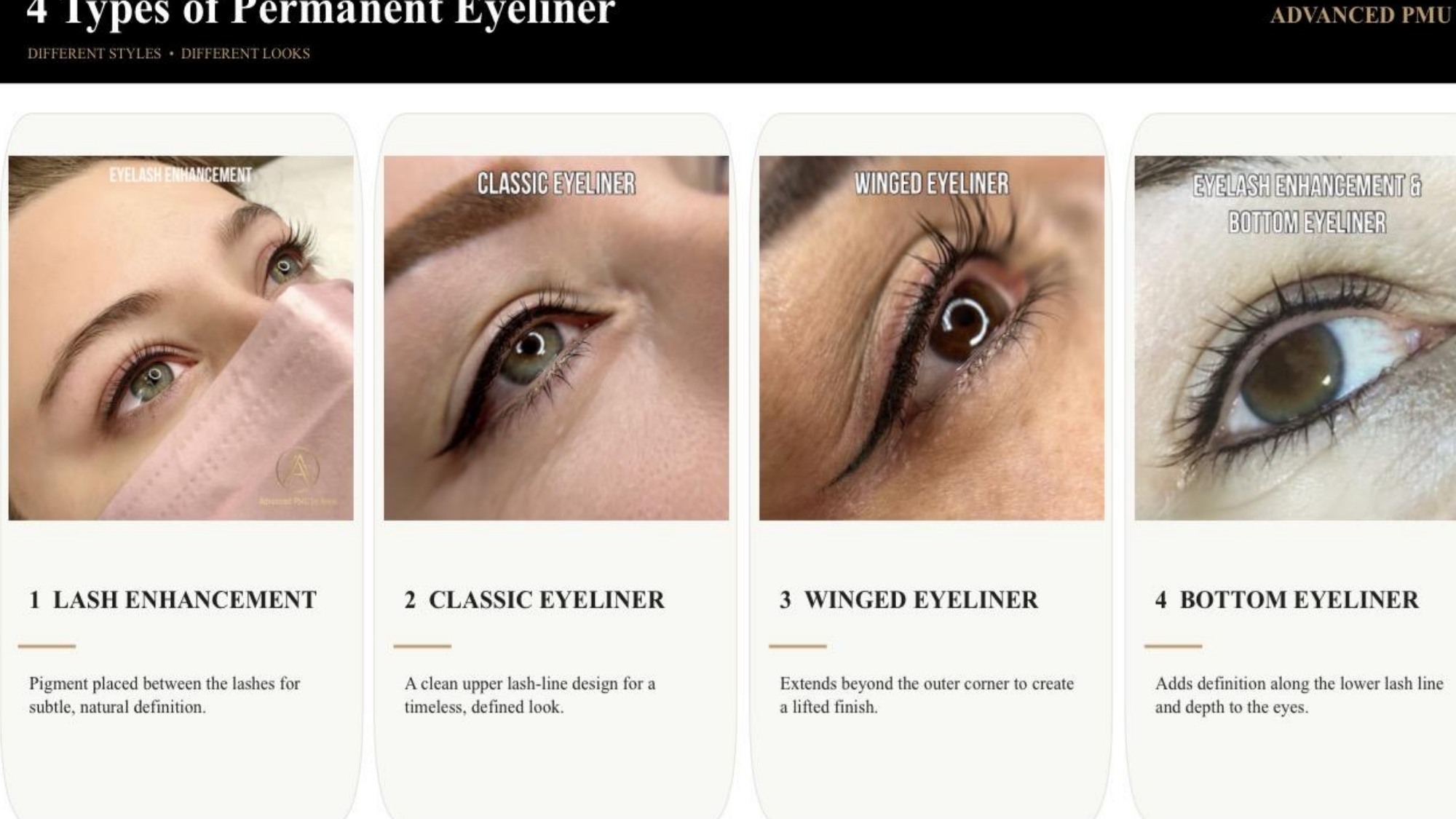
The 4 Major Permanent Eyeliner Styles
| Eyeliner Style | Anatomical Placement Boundary | Optical Visual Result | Best Client Morphology |
|---|---|---|---|
| Lash Line Enhancement (Tightline) | Strictly within the natural lash follicle row | Natural dark base; illusion of thicker eyelashes | Universally flattering; ideal for mature, deep-set, or hooded eyes |
| Classic Eyeliner | Lash line plus smooth, defined upper contour | Defined makeup eyeliner look with clean borders | Smooth eyelid skin, open lid space, non-hooded morphology |
| Winged Eyeliner | Classic line with extended lateral tail flick | Dramatic upward lift and cat-eye contour | Almond eyes, taut skin, symmetrical lateral orbital rims |
| Stardust / Shaded Eyeliner | Tightline base with graduated pixel shadow dusting | Soft smoky eyeshadow effect; diffused edges | Deep-set eyes, mature lids desiring softness without sharp borders |
Critical Ocular Anatomy & Safety Exclusion Zones
| Anatomical Zone | Location Relative to Lashes | Histological Vulnerability | Mandatory Clinical Safety Rule |
|---|---|---|---|
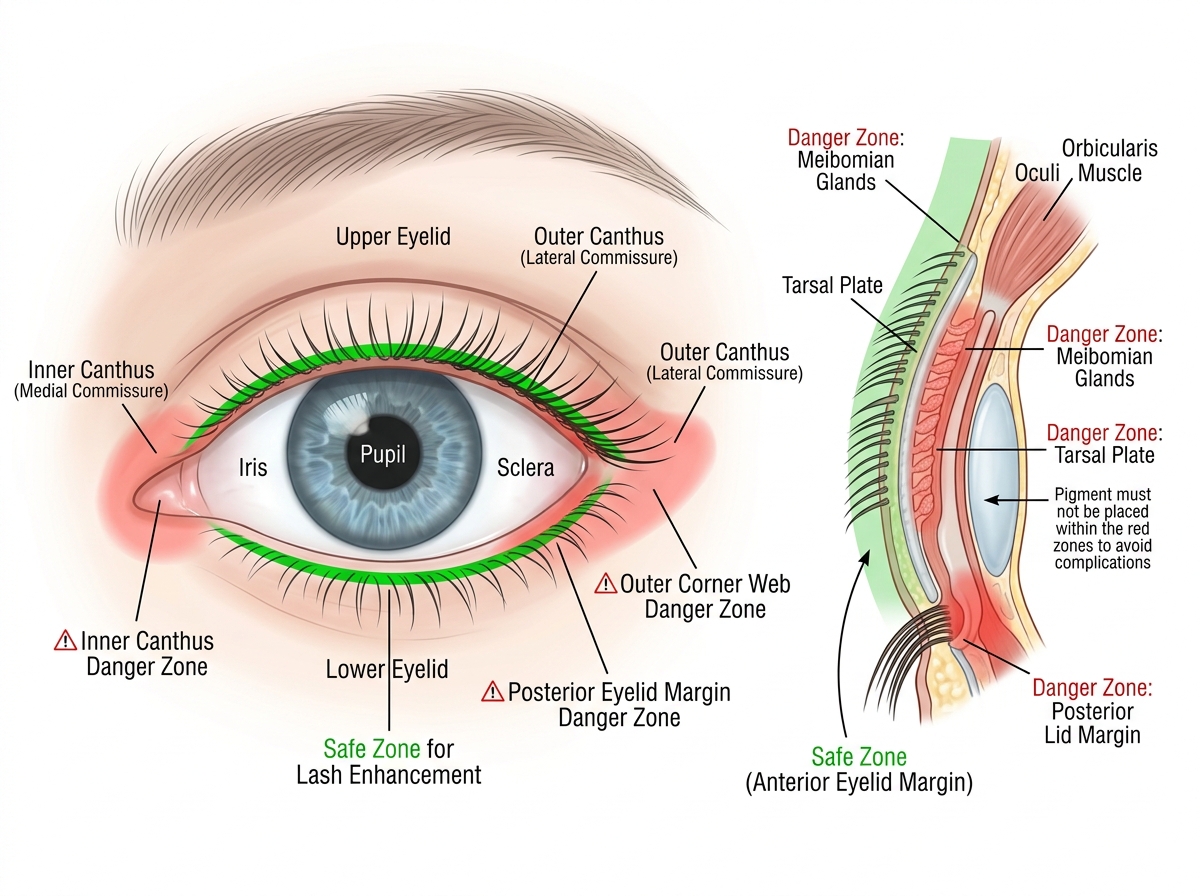
| Meibomian Glands | Wet inner waterline (posterior eyelid margin) | 25 to 30 oil-producing sebaceous gland orifices per lid | Strict Waterline Ban: Never tattoo into gland orifices. Destroys lipid tear film and causes chronic dry eye disease. |
| Lacrimal Punctum | Medial (inner) canthus corner | Tear drainage canal | Stop tattooing 2mm to 3mm before the inner tear duct to avoid tear duct canal scarring. |
| Tarsal Plate | Dense fibrous connective tissue layer | Structural framework housing meibomian glands | Maintain superficial papillary dermis depth; never pierce into fibrous tarsus. |
| Cornea | Anterior transparent eye globe surface | Delicate non-vascularized epithelial dome | Zero needle or chemical contact. Keep eyes closed and flush immediately with ophthalmic saline if exposed. |
The Clinical Necessity of the Strict Waterline Ban
The wet inner margin of the eyelid (the waterline) contains the delicate duct orifices of the Meibomian glands:
- The Function of Meibomian Glands: The upper eyelid houses 25 to 30 vertical glands, while the lower lid contains 20 to 25 glands. These specialized sebaceous glands continuously secrete meibum, a clear lipid oil that forms the outermost layer of the tear film. This lipid layer prevents the aqueous tears from rapidly evaporating into the air.
- The Permanent Damage of Waterline Tattooing: If a needle penetrates the waterline, it punctures the gland orifices and deposits insoluble pigment particles into the glandular ducts. This causes chronic granulomatous inflammation, duct obstruction, and irreversible fibrotic destruction (gland dropout). The patient develops severe, permanent evaporative dry eye syndrome, accompanied by chronic burning, foreign-body sensation, corneal ulceration, and photophobia.
- Scleral Blowout Hazard: The mucosal tissue of the waterline connects directly with the palpebral and bulbar conjunctiva. Liquid pigment deposited into this vascular, fluid-rich mucosal bed can travel along conjunctival capillaries, creating an immediate, irreversible scleral blowout across the eyeball.
- The Clinical Standard: All permanent eyeliner tattooing must remain strictly anterior to the grey line within the safe, lash-bearing cutaneomucosal zone. If a client requests waterline tattooing, refuse firmly. "Saying not today or not me is an advanced clinical skill."
Eyeliner Clinical Safety and Anatomy Zones
Visual Reference Summary