[!NOTE]
What you are doing: Analyzing the biochemical components of cosmetic tattoo pigments.
Why you are doing it: Pigments behave differently in tissue depending on particle size and carrier viscosity.
How you know it is right: You can read any pigment ingredient label and predict how it flows and heals.
[!TIP]
How to study this academy. This course is not "copy a voltage." It is practice in thinking like an artist. Every lesson answers three questions: What am I doing? Why am I doing it? How do I know I am doing it correctly?
>
Work in this order: Learn, then practice on silicone, then check your own work, then correct, and only then consider a live model. Licensing, supervision, insurance, and facility rules are yours to meet where you work. This course teaches skill and judgment. It does not replace those rules.
>
Healed work is the standard. A fresh result is darker, sharper, and often swollen. The result a client lives with is lighter and softer, and it shows the true color. Retention is not earned by going deeper. It is earned by controlled implantation and healthy healing.
>
Judge a healed result on six things: a shape that belongs on that face, edges that look soft rather than stamped, color that suits the client, even retention, skin that shows no trauma, and a result that still looks like brows, liner, or lips.
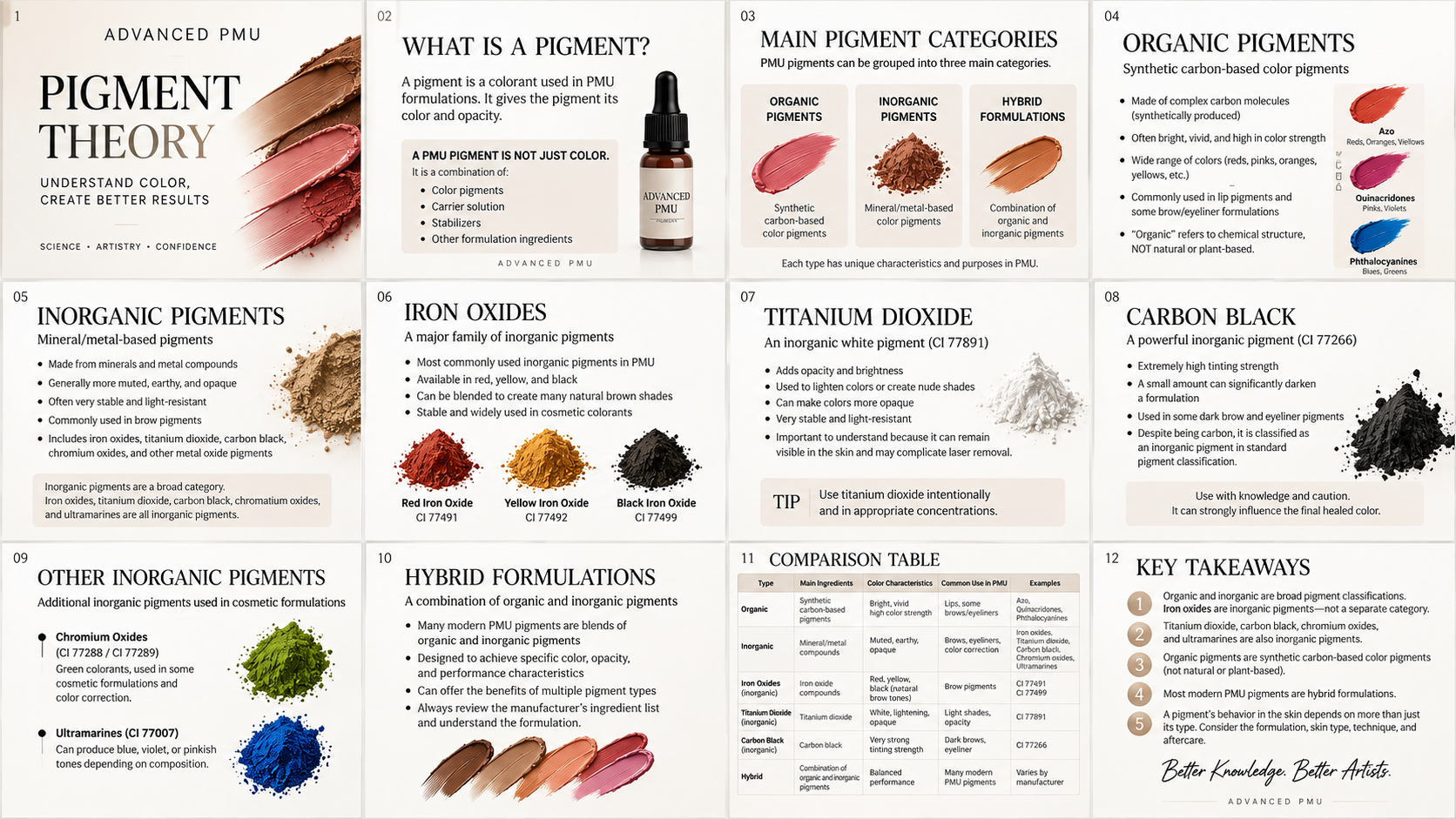
A permanent makeup pigment is never just raw color. It is an engineered chemical suspension designed to be safely implanted and retained within the papillary layer of the dermis.
The 4 Core Components of a PMU Formulation
1. Colorant Particles: The dry powdered organic or inorganic pigments that provide color, saturation, and opacity.
2. Carrier Solution: The liquid vehicle that suspends dry pigment particles, lowers surface tension, and facilitates capillary needle pickup.
3. Dispersants & Surfactants: Chemical agents that prevent pigment particles from clumping together in the bottle or separating over time.
4. Preservatives & Stabilizers: Prevent bacterial and fungal contamination after the bottle seal is broken.
Carrier Solution Chemistry & Drying Kinetics
The carrier solution dictates how quickly your pigment dries on the skin and how smoothly it releases from your needle cartridge:
| Carrier Ingredient | Viscosity & Flow | Drying Speed | Skin Sensation | Best Technique Application |
|---|---|---|---|---|
| Sterile Water | Ultra-low viscosity, fast capillary flow | Fast evaporation | Neutral, gentle | High-speed machine pixelation and soft ombre dusting |
| Hamamelis (Witch Hazel) | Low viscosity, smooth fluid glide | Moderate evaporation | Mild astringent, tightens pores | Universal shading, linework, and clean wipedown |
| Glycerin | High viscosity, thick syrup texture | Very slow drying | Rich, hydrating | Manual microblading and dense rotary color packing |
| Isopropyl Alcohol Additive | Very thin, reduces surface tension | Instant evaporation | Mild tingling | Rapid dispersion formulas for fine needle cartridges |
Particle Size & Dermal Implantation Dynamics
The physical diameter of a pigment particle determines its biological fate in human skin:
| Particle Size Range | Typical Pigment Types | Dermal Stability | Macrophage Reaction | Visual Healing Result |
|---|---|---|---|---|
| < 1 Micron (Nano) | Fine synthetic colorants (example: Pyrrole Red 254). Carbon black is filed separately below. | High mobility, rapid absorption | Readily engulfed; risk of capillary migration if too deep | Intense color saturation, vibrant and transparent |
| 2 to 5 Microns | Hybrid & Medium Synthetics | Balanced tissue stability | Trapped securely inside dermal macrophages | Crisp, distinct pixelation with minimal blur |
| > 5 Microns | Heavy Inorganic Minerals (Iron Oxides) | Sits firmly in tissue, high opacity | Fully immobilized; highly resistant to migration | Soft, earthy matte finish with uniform, predictable fading |
[!TIP]
Downloadable Student Resources:
Visual Reference Summary